

A Little Cash Bribe: Get Laughs about TV
Turn your TV viewing into inspiration for your stand-up material

Hello stand-up comedian (or anyone else who wants to write funny)
In these posts I give you inspiring prompts to fuel your writing. The Stand-up Comedy Writing Games (TM) for you to play with in this post are:
Itemising types
What If?
The first finds comedy in how things are and the second gets you to ask - what if things were different?
──────────────────────────────────────────────
Itemising types
Trying to write some stand-up? Don’t just sit there staring at a blank page or screen, watch TV!
Here’s a classic approach to a TV show you can take in your stand-up writing:
Identify all the repetitive tropes and character types and itemise them.
John Mulaney, clearly a long-term viewer of Law & Order, identifies all the character types that routinely appear on the show. He gets laughs of recognition from the audience as he acts out these typical types with a heightened sense of disbelief. Clip
For example, when an investigator comes in with a photo of a suspect, they meet a New York city bartender who remembers everyone who has ever been in the bar. What makes Mulaney’s take on this so comic is his heightened act out of the character types and his attitude of mock disbelief at the absurdity of it all.
Meanwhile, Iliza Schlesinger itemises types of shows. She says:
“There are other things tearing at the moral fibre of our country besides breakfast. There’s also a network called TLC.”
She goes on to say that TLC stands for The Learning Channel but that it should really stand for…. Okay, I was going to type it up but it’s very long! Check out the clip for the name and for what follows....
“They have a whole stable of shows all centered around the idea that women eat weird shit when they’re lonely. They have My Strange Addiction. Not to be confused with Freaky Eaters. Not to be confused with a totally different show, My Crazy Obsession. Not to be confused with their hit show, That’s Not Food. Please Don’t Eat That.”.
Here we have three genuine titles and an absurd mocking version as the fourth in the list. The classic approach would be to make it a rule-of-three and have two genuine ones with a twist on the third (establish/ reinforce/ surprise).
But in this case she wants to really hammer home how many of these shows there are, so goes for three in the build up and a twist on the fourth. As you itemise the absurd elements of the TV show, or shows, you are writing about, considering adding an absurd parody one on the end.
TIP: whenever you have a list, always add a silly one on the end
You’re in the space here of observational comedy and laughs of recognition. In the second step we will go into the ‘what if?’ space.
What if?
While it’s cathartic (and potentially very funny) to rant about terrible shows - or to pick apart the tropes of a great show (taking a contrarian stance) - to take it somewhere more surprising ask yourself:
“What if it were different?”
This “what if?” writing game is one we’ll return to throughout these posts (in many different ways) because it takes you out of simply talking about how things are (which a lot of people get stuck in with their stand-up writing) and into how they could be.
Play with following questions and see where it takes you as you write stand-up comedy on a TV show.
What if it were set somewhere else?
What if the kinds of people on the show were different?
What if it were set in a different time period?
All of these can take you to a funny angle. And here’s one I want to delve more deeply into:
What if I were on it?
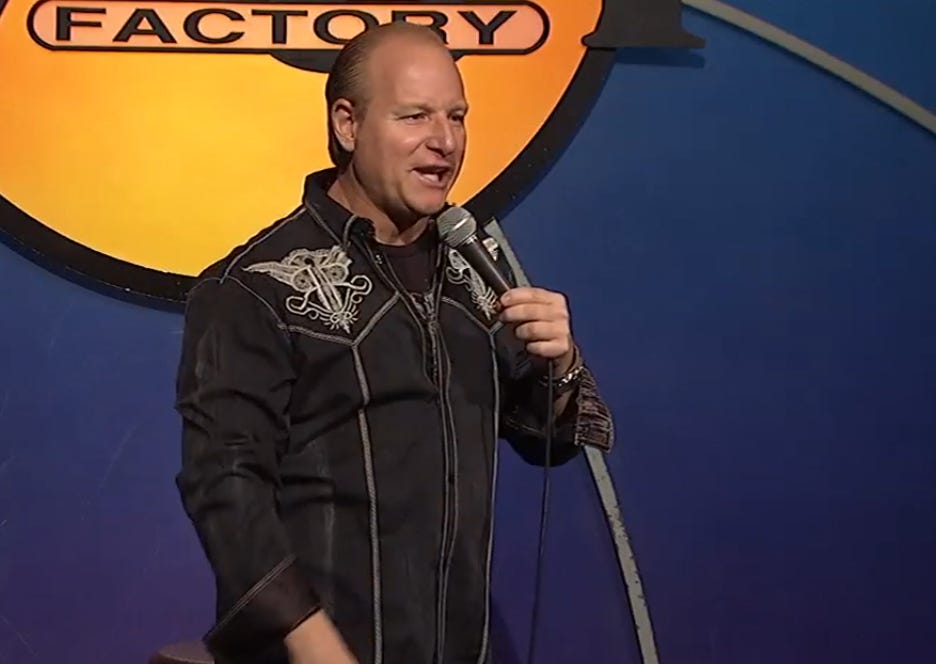
In this example from Mike Marino, he imagines his entire family on Family Feud (known as Family Fortunes in the UK). He sets it up by saying his elderly mother from New Jersey is visiting him in Hollywood. Marino asks her what she’d like to do and he says:
“I swear, my mother goes, ‘I want to go on the Family Feud with the family.’”
This is a great way of introducing the idea. He’s not presenting it as his funny idea. He makes out it’s his mother’s unexpected desire. He goes on:
“Come on, people, think about that. You never saw an Italian family on a game show ever! We would beat the shit out of each other during the commercial break.”
He then paints a picture of the show.
“Y’all remember the family feud when Richard Dawson was the host? And somebody in the family get like the dumbest answer you ever heard. Get the whole family standing there going, ‘Good answer. Good answer. That’s gonna be on the board’.”
He then undercuts this positive (albeit misguided reaction) with how his own family would respond:
“I can just imagine my family. Somebody gave a bad answer, you’d see my father go, ‘The fuck is the matter with you? Come on, asshole. That’s not gonna be up on the board’.”
He describes the fracas that follows and then goes on to say:
“And then you’d see, like, a little cash bribe go down, right? A little money exchange would happen like this..”
Then he goes into an act-out:
‘Oh, Mr. Dawson, wanna come over to the family? I wanna talk to you about something. All right, listen, don’t get excited... Here’s what we’re gonna do. There’s an extra $200 cash. You put this in your pocket. That’s for you. Now you ask my mother the question again. She wasn’t ready.”
Here’s the clip:
✍ TRY IT YOURSELF
Pick a TV show you love or hate or you feel is ridiculous or illogical or embarrassing. This can be one specific show or a genre of show.
Step 1: Itemise
Itemise character types, narrative tropes, etc. Perhaps adding your own absurd example on the end. Played right with act-outs and attitude, this can be enough for laughs of recognition.
When I work with stand-ups on their material, it’s striking how often they simply talk about how things are and don’t go into the ‘what if?’ space. So, once you’ve rinsed the actual circumstances for comedy, ask yourself how things could be (radically) different and play around in this flight-of-fancy space.
Step 2: ‘What if?’
Now you’re asking, what if the show were different? These angles I mentioned are well worth playing with:
What if it were set somewhere else?
What if the kinds of people on the show were different?
What if it were set in a different time period?
And do have a go with this one we focused on:
What if I were on the show?
If it’s a game show or a reality show, it’ll be natural for you to imagine yourself on it. But even with dramas you can consider what would happen if you’d shown up in the fictional world. Ask yourself:
How would I (and anyone with me) behave?
How would the other characters/ participants react?
How would it change the show?
Every great stand-up premise begins with observing reality.
The next step is asking one simple question...
“What if?”
That single question can take a simple bservation into a big comic idea.
──────────────────────────────────────────────
What tropes have you noticed on TV shows? What if these shows were different? What if you were on it?
Leave a comment below or reply to this email.
See you next week!
— Chris